Boroondara
Thomas Sweeney's name is synonymous with his property Culla Hill in Eltham. But this was not the first property on which he settled upon his arrival in Melbourne and it was not his first choice for ongoing settlement. Let us explain.
It is
presumed that when Thomas and Margaret Sweeney arrived in Melbourne in
1838, they had brought with them one hundred pounds to invest in land.
Most likely they had sold assets in Sydney or the Illawarra. This would
equate to around a year of average income in this present era, so we
can see that it was actually a considerable sum at that time. The
standard price for selected Crown land was one pound per acre.
In
1840 Thomas Sweeney appears in a list of persons licenced to depasture
stock in the Districts of Melbourne and Geelong from the 1st of July
1840 to the 30th of June 1841. Records show that he occupied 146
acres on the south bank of the Yarra River seven miles from Melbourne
in the Parish of Boroondara. In the Census of the year 1841 dated the
11th of March, ‘Thomas Sweeney of Yarra Yarra’ has a completed wooden
dwelling on the land occupied by five adults and one child. Patrick is
aged two years and four months. Apart from Thomas and Margaret the
household includes three single males, one aged under 45 and the other
two between 45 and 60. Apart from being a farmer, Thomas is later
described as being a sawyer, so perhaps these men were involved in
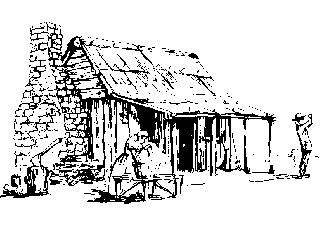
timber cutting. There is no record of the dimensions of the dwelling,
but in a later description it is called a hut. Space would have been an
important concern after Margaret gave birth to twin daughters Catherine
Agnes and Margaret Augustina on the 19th of May 1841. In the St Francis
Church Register of Baptisms the place of abode is, ‘East Kew,
Boroondara.’
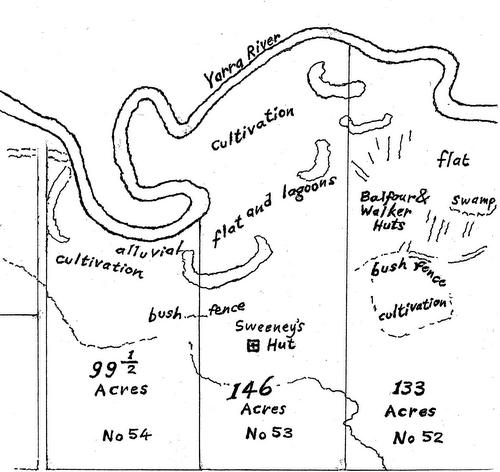
This map, based on a drawing of 1845, shows the Boroondara allotments which were then up for sale. The Sweeney hut and 146 acre allotment is marked. Huts for fellow squatters David Balfour and John Walker were also recorded. The sale notices stated that huts and bush fences were still in situ at that time. some 2 years after Thomas had moved on..
The land in Boroondara occupied under licence by the Sweeneys was basically an alluvial river flat with lagoons, some surviving trees and a stockyard. The alluvial flats with flood enriched soils were generally ideal areas for cultivation and grazing, with timber-getting being a reliable income as long as it lasted. The trees were initially felled by squatters for huts and fences, and wood was always needed for cooking and heating. Floods were a problem for anyone living close to the river and when they were severe, crops had to be replanted, huts repaired and fences rebuilt.
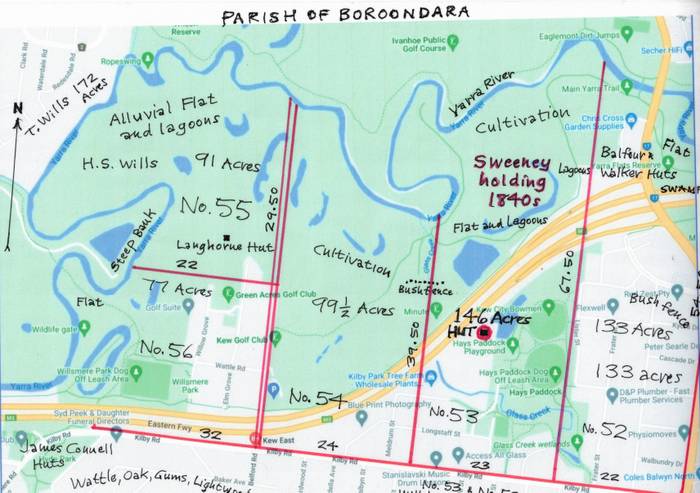
This modern map, to which Peter Cuffley has added words and boundaries, shows exactly how the Eastern Freeway has now cut through Thomas Sweeney's 146 acre Boroondara leasehold. Thomas was keen to buy it in the 1840s, but was not to know it would mostly become reserved land and later be affected by a freeway and the Burke Road on and off ramps.
In 1842, Thomas
applied to buy the land on which he was squatting but this was refused.
Given this, he must have gone exploring further up the Yarra River and
eventually he put in a request to purchase a portion of land containing
110 Acres in the Parish of Nillumbik. This request was allowed and by
1843, it had been ratified and a Certificate of Title issued.
This was to become Culla Hill, the property on which he would see out his remaining days.
An
important insight into the lives of Thomas and Margaret Sweeney prior
to taking up their land in Nillumbik comes from a letter written by
Thomas in Melbourne on January 27th 1843 to G.S. Airey Esq.,
Commissioner of Crown Lands. This letter is reproduced below.
The ‘Mr. Bellfleur’ referred to is David Balfour, who with John Walker was on the adjoining parcel of land in the Parish of Boroondara, also held under licence.
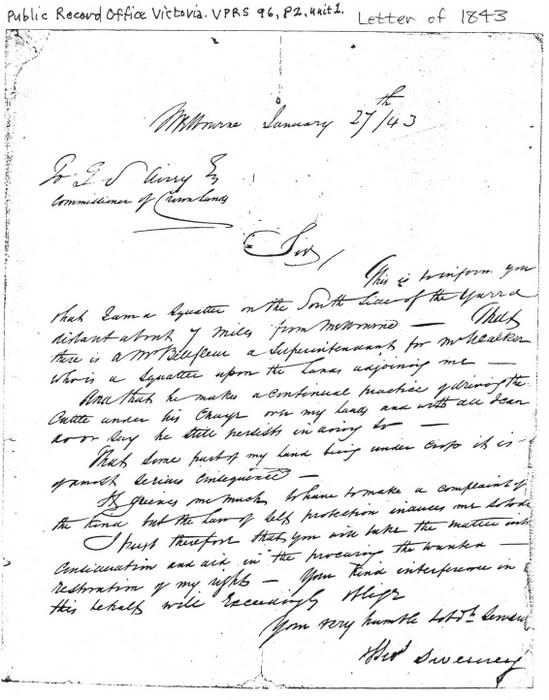
You can read all about this incident and what happened subsequently in Chapter 8 of Peter Cuffley's book The Sweeney Family of Culla Hill Eltham.
Tim Erickson, Tuesday 22 July 2025